


July 2026
Alfalfa’s Summer Slump!
Decline in yield. Decline in growth rate. Decline in feed quality. This is the alfalfa summer slump!
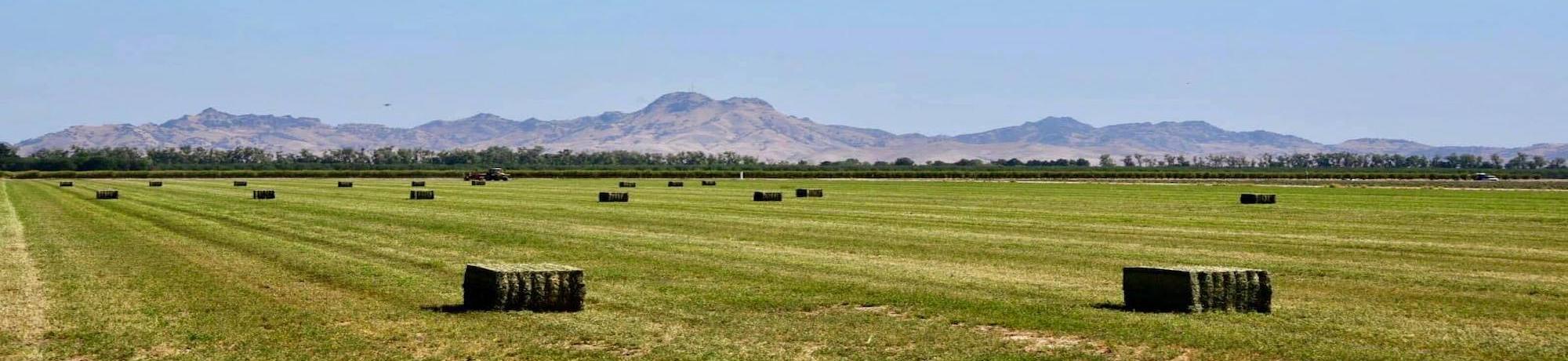
Summer slump happens when daytime temperatures reach the 95-105 F range. Nighttime temperatures stay elevated to 70-80 F. Extreme as these temperatures may be, they are often exceeded. Temperatures regularly reach 115-120 F in the California desert hay growing areas.
For alfalfa, the first impact is reduced growth rate and yield per acre. Reduced yield is often in the range of 15-30% fewer bales produced.
Feed quality deteriorates. Fewer leaves are produced. Hay quality factors including RFV, TDN and crude protein all decline. High temperature triggers a reduction of photosynthesis related proteins (2). Crude protein in harvested hay is reduced (1).
Chlorophyll production is reduced. Fewer leaves result in reduced carbohydrate production. Digestible carbohydrates decline.
The plant’s metabolic respiration increases. Energy demand is at its peak at the precise time that energy production is at its lowest.
Roots metabolize carbohydrates at a higher rate. Fewer leaves and reduced chlorophyll. Sugars, starches, and pectin from leaves do not sufficiently replenish energy supplies in the roots. Energy deficit grows within the roots.
Why does it matter?
Perhaps alfalfa is a “plant out of place” in the Western US. It is a perennial legume. A cool season plant with warm-season tolerance. Cool season plant or not, it grows so vigorously that up to ten hay cuttings happen on the same field each year. Summer slump is a natural result of the desert heat finally overcoming the warm season tolerance of the hardy plant.
For many growers, yield and quality can be seen declining with successive harvests after the day and nighttime patterns are established. This drop in yield, quality and sales value begins in June or early July. Revenue from each successive cutting, based on yield and quality declines as the slump deepens.
Years of alfalfa production and field research in the desert has demonstrated that summer slump can’t be “cured.” But we can help “flatten the curve.”
Citations:
1) Rethwisch, Michael D., Reay, Mark, September 2003. University of Arizona University Libraries. Effects of foliar fertilizers and carbohydrates on alfalfa yields and quality during the summer slump period.
2) Yingzhu Li, et.al. December 2021. Frontiers in Plant Science, www.frontiersin.org.
Guarantee Complex for Flattening the Curve
Guarantee Complex (0.2-0-6) seems to be a tailor-made answer for easing desert grown alfalfa through the slump.
Guarantee Complex (0.2-0-6) is an Ascophyllum nodosum based seaweed extract product. It provides the heat stress resilience that Ascophyllum nodosum is known for. Using Ocean Organics’ formulation expertise, it provides potassium, amino acids and osmo protectants which are welcomed in an environment of reduced protein synthesis, reduced carbohydrate, and run-away energy consumption.
Summertime harvests of replicated trials in Blythe, California have demonstrated encouraging results.
In cutting #6: Yield 27% increase over non-treated control. Quality: RFV 154 vs RFV 119! Earlier harvests leading up to cutting # 6 produced similar improvements in cuttings #4 and #5.
Application rates for Guarantee Complex (0.2-0-6) were at one quart per acre and two quarts per acre. Both rates provided satisfactory results in terms of yield and quality.
How can Guarantee Complex (0.2-0-6) do so much with such a small per acre application rate?
The answer lies in two essential factors:
1) The growth promotion effects found in Ascophyllum nodosum extracts and
2) The timing of the application relative to the small size of recently mowed alfalfa plants.
Ascophyllum nodosum extracts are known for their power to promote plant health and vigor. These extracts are frequently referred to as elicitors of biochemical chain reactions These chain reactions are stimulators of plant growth processes. Plant health and vigorous growth are the result of their use.
The presence of potassium is critical to stress resilience. Potassium is the driving element of stomatal guard cell mechanisms. Potassium applied to leaves affects water vapor and atmospheric gas exchange. Potassium controls stomatal guard cell opening and guard cell closing. The two gas exchange processes are critical to plant health under heat stress conditions. Water vapor controls the plant’s internal water stress. Carbon dioxide gas in stomatal chamber directly regulates the plant’s energy use and energy production.
Timing of Guarantee Complex (0.2-0-6) application is a key to good response. Guarantee Complex (0.2-0-6) should be applied after each successive cutting and bale pick up. Plant height is usually between 2 inches and 6 inches tall at this time. Plants of this size are suited to be well covered in a spray application which is often a tank mix with other nutritional products. Positive results may result from spray material arriving on the soil under the recently shortened plants.
Irrigation water is an effective means to apply Guarantee Complex (0.2-0-6). Injection into the water run along with other nutritional materials is an economically sound technique. Irrigation usually happens soon after cutting and the bales are picked up. Tank mixes are encouraged.
Growers can be creative about their application technique for Guarantee Complex (0.2-0-06). Field research has demonstrated positive results from flood irrigation applications and with low volume spray applications.
See Our Complete Line of Plant Health Solutions


Art Dawson, Ph. D.

Greg Cosman, BSc. Agr.


Member of the Maine Seaweed Council
Copyright ©2026 Ocean Organics – all rights reserved.
The Ocean Organics wordmark and stylized logo are registered trademarks of Ocean Organics